
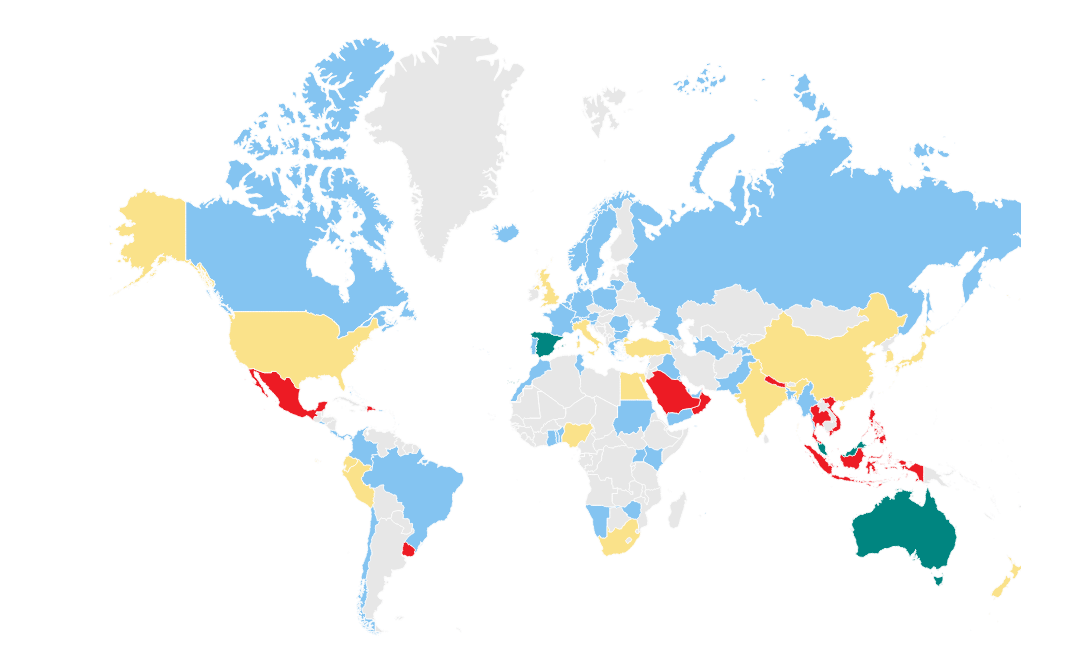
| Below Average | Average | Above Average |
Reached via #DQEveryChild but country data is inconclusive
Real-Time Measure for Country’s Child Online Safety
The Child Online Safety Index (COSI), the world-first real-time measure to help nations better understand their children’s online safety status.
The 2020 COSI is based on data collected from 145,426 children and adolescents in 30 different countries from 2017-2019 as part of the #DQEveryChild initiative.
Linked with DQ assessment tools and its global database, COSI will be automatically updated as the countries progress with their child online safety and digital citizenship initiatives.
via Social Media
Read the Press Release
The COSI Framework
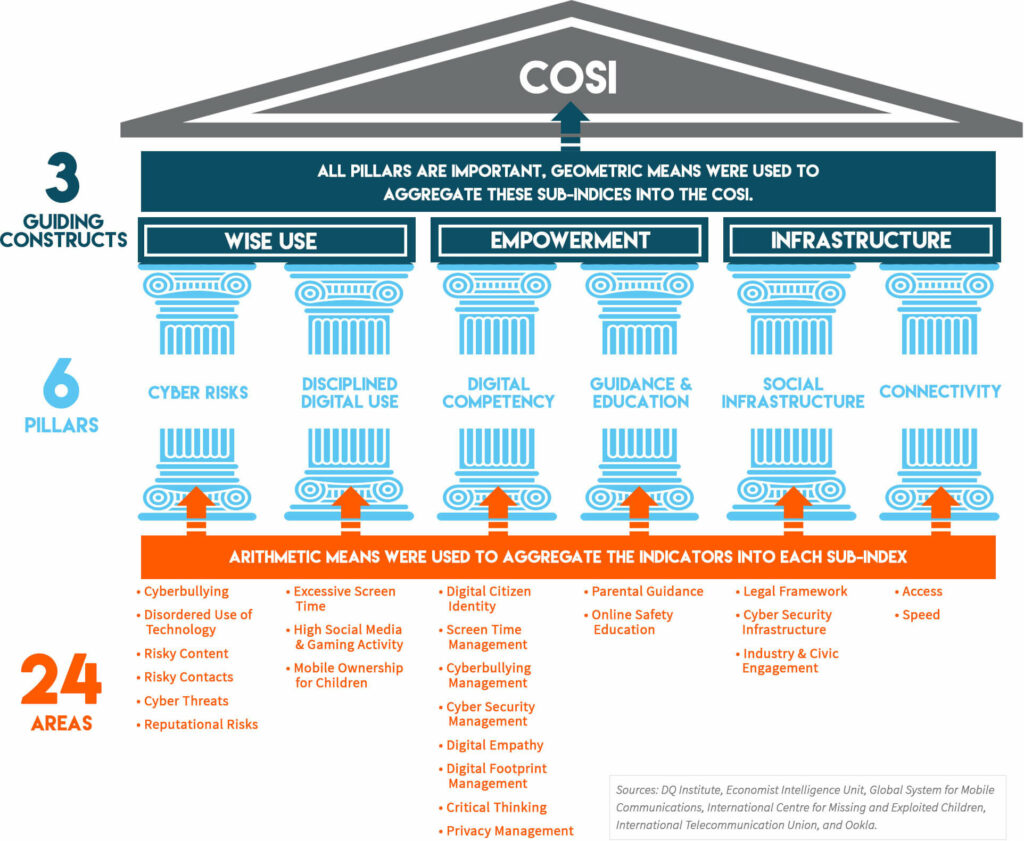
The Child Online Safety Index (COSI) measures the level of online safety for children across the world based on six pillars: Cyber Risks, Disciplined Digital Use, Digital Competency, Guidance & Education, Social Infrastructure, and Connectivity. Each of these pillars are formed by 2-8 focused areas, allowing for a comprehensive assessment of online safety for children. A COSI score was calculated for each country ranging from 0 (the worst online safety for children) to 100 (the best online safety for children).
The 6 Pillars of COSI
CYBER RISKS
Assesses whether children are exposed to cyber risks such as cyber-bullying, risky contacts, or disordered use of technology
DISCIPLINED DIGITAL USE
Assesses whether children are spending excessive amounts of time with electronic devices and media
DIGITAL COMPETENCY
Assesses whether children have digital skills, such as digital empathy and digital footprint management, that minimize cyber risks and allow them to be good digital citizens
GUIDANCE AND EDUCATION
Assesses whether children are supported by the guidance of caregivers and school education about online safety
SOCIAL INFRASTRUCTURE
Assesses whether governments and industries operate in ways that protect children from cyber risks
CONNECTIVITY
Assesses whether children can access the internet with sufficient speeds
Country Level Report
Country Average Global Average |
Key Findings:
|
|||||||||||||||||||||||||||||||||||
- Cyber Risks
- Disciplined Digital Use
- Digital Competency
- Guidance & Education
- Social Infrastructure
- Connectivity
- The frequency of children and adolescents' involvement with cyberbullying activities
- The frequency of children and adolescents' involvement with cyber-victimization activities
- The percentage of children and adolescents affected by cyberbullying
The Development of COSI
Two years ago, on Safer Internet Day (6th February 2018), the 2018 DQ Impact Report was published in association with the World Economic Forum. That initial report examined online safety and digital citizenship among 38,000 8- to 12-year-olds across 29 countries. Our key finding at that time was that 56% of children were exposed to at least one cyber risk (including risks like cyberbullying, gaming disorder, offline meeting with strangers, and online sexual behaviors). This report created an impetus to expand and deepen our knowledge of the risks children face, as well as what resources act as protective factors.
In the two years following, we have broadened our vision and increased our measurements to examine six major pillars of support for children’s online safety. This 2020 COSI compares the results across 30 countries, and includes data from over 145,426 children, as well as from other external sources such as the International Telecommunication Union (ITU), Global System for Mobile Communications Association (GSMA), Economist Intelligence Unit, and others. Learn more about our key findings and methodology in our full report below.
COSI is dedicated to monitoring trends in Child Online Safety around the world with real-time updates. We invite the academic research and expert communities to work together with us to further improve COSI. We especially welcome suggestions of how COSI can become more relevant to researchers’ own countries. If interested, please contact us at partnership@dqinstitute.org.
ImpactResearch
What is the impact of digital media and technology on children and its implication to national and global society?
What are effective ways to provide safe and creative digital education eco-system for all children around the world?
DQ Institute adopts an evidence-based and data-based approach. DQ metrics were developed through data analytic research through multi-national studies based on a multi-disciplinary approach.
We invite researchers, educators, and organizations around the world to tackle these issues to be part of our DQ Research Network.
Country Average
Global Average